Lithium batteries are the newest technology when it comes to trolling motor batteries. Lithium batteries are able to be used with Minn Kota products. There are a few considerations listed below to look at when deciding on Lithium batteries.
Jump to:
- Using Lithium Batteries with QUEST Motors
- Using Lithium Batteries with Brushed Motors
- Safety when using Lithium Batteries
- Lithium Features
- Cost
- Power Output
- Continuous Discharge Amperage
- Charging
- Charging Profile for PCL Chargers
Using Lithium Batteries with QUEST Motors
The QUEST series trolling motors are crafted for smooth operation on 24- or 36-volt systems. Optimized for LiFePO4 lithium-ion battery cells, these motors harness the higher and more stable voltages that lithium batteries offer compared to traditional lead-acid batteries, resulting in enhanced efficiency and overall performance. Despite being tailored for lithium batteries, QUEST motors are also fully compatible with deep-cycle marine batteries.
Using Lithium Batteries with Brushed Motors
Lithium batteries sustain higher voltage levels over extended periods, which can be too powerful for motors designed specifically for flooded lead-acid batteries. Running the motor at maximum speed with lithium batteries can result in damage. To avoid this, it’s recommended to limit the motor speed to 85%, or Speed 8.5 or lower.
Using Lithium Batteries with Raptor Shallow Water Anchors
A Raptor will operate with a Lithium Ion battery. Avoid connecting the Raptor to the same batteries that a trolling motor or other accessories are connected to.
Using Lithium Batteries with Talon Shallow Water Anchors
The Talon will operate with any lead acid or lithium, marine 12 volt battery. Maintain battery at full charge. Proper care will ensure having battery power when you need it, and will significantly improve the battery life.
Safety when using Lithium Batteries
To ensure safety and compliance, it’s essential to adhere to the relevant marine regulations and standards for battery choices in different regions. Always consult local and/or in-country marine regulations and standards when selecting and installing batteries for your trolling motor to ensure compliance and optimal performance.
- United States: Use only batteries that meet U.S. Coast Guard regulations and applicable American Boat and Yacht Council (ABYC) standards. ABYC’s E-13 standard for lithium-ion batteries ensures safety and reliability in marine environments.
- Canada: Comply with Transport Canada’s Transportation of Dangerous Goods (TDG) Regulations, which govern the safe handling, packaging, labeling, and transportation of batteries, particularly lithium batteries classified as dangerous goods. Marine safety guidelines provided by Transport Canada further ensure environmental protection and operational safety when using batteries on vessels.
- Europe: Follow the European Union’s Batteries Regulation, which promotes sustainability, performance, and safety throughout a battery’s life cycle.
- Australia: Comply with the Australian Maritime Safety Authority (AMSA) regulations and standards, which emphasize maritime safety and environmental protection.
- New Zealand: Align with Maritime New Zealand’s standards, which provide guidance on the safe use of lithium-ion batteries on vessels.
Lithium Features
Lithium batteries provide continuous power to the motor and do not experience the power drop traditional deep-cycle batteries experience as the battery drains. This provides a consistent experience when using the trolling motor and increasing runtime. Lithium batteries are also weigh significantly less and have a longer lifespan
Cost
Lithium batteries are more expensive than other batteries and may also require a specific charger adding to the cost of the battery.
Power Output
-
QUEST Motors
QUEST series trolling motors will operate with any deep cycle marine 12, 24, or 36-volt battery/batteries and have been optimized for use with LiFePO4 Lithium Ion battery cells. Lithium Ion batteries maintain higher voltages for more extended periods than lead-acid batteries and will provide the best performance in powering the trolling motor. -
Brushed Motors
Lithium Batteries maintain higher voltages for longer. Motors engineered to make the most of flooded lead acid batteries can be damaged by the higher power output. To prevent this damage when using Lithium batteries you should not run your motor at its highest speeds, staying at 85% Speed 8.5 or lower.
Continuous Discharge Amperage
When using lithium batteries, you want to ensure the battery(s) provide(s) enough continuous discharge amperage to run the motor at its max amp draw. The chart below shows the max amp draw by motor thrust. When the Amp Draw of the motor exceeds the battery rating the battery’s management system will restrict power to the motor which may cause the motor to shut off or perform erratically including working for a short time and then shutting off, being able to turn on the motor but not turn on the prop, steering issues, and issues with Advanced GPS Navigation, i-Pilot Link, and i-Pilot such as Spot Lock not working or being erratic. If you are having any issues with your motor and you are using Lithium batteries, verify you have enough continuous amperage available for the motor to pull its max amp draw.
Charging
When charging Lithium batteries, you may not be able to use the charger you currently have. The battery manufacturer will be able to provide the details for charging the battery(s). You will want to make sure the charger provides enough amps per bank, is able to accommodate a battery management system if included as part of your lithium battery, and has or does not have multi-stage charging (based on your batteries needs).
Minn Kota PCL Chargers
When doing research on lithium batteries and trying to determine their compatibility with a Minn Kota PCL Charger there are two important battery specifications to consider: Charge Current and Charge Voltage.
- Charge Current- This is the amp output of each bank is on the charger you select. Example MK 330PCL is 3 banks of 10 amps per bank, so the charge current is 10 amps.
- Charge Voltage- This is listed differently depending on the battery manufacturer. Some common terms used include Charge Voltage, Max Charge Voltage, Absorption Voltage. It important to ensure our Max voltage of 14.5V meets the specifications of the Battery Manufacturer.
Charging Profile for PCL Chargers
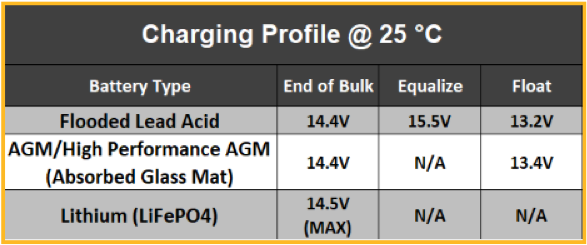
Note: Always check with your battery manufacturer to verify the charging profile is compatible with your Lithium battery.